

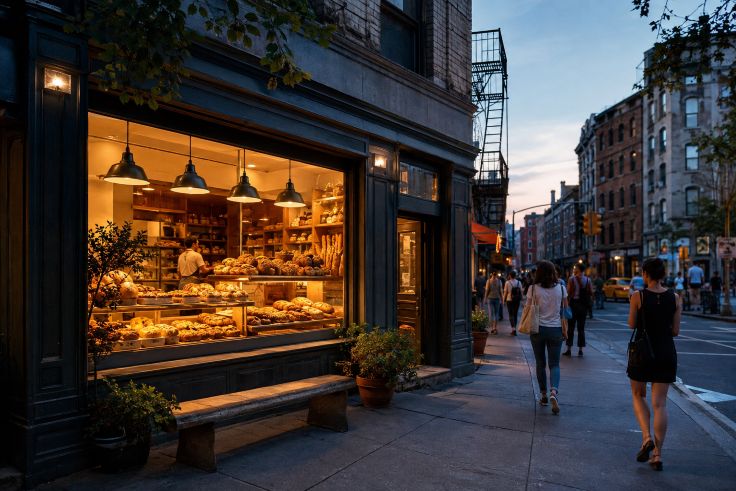
New York City has about 142,000 storefronts, and roughly 15,700 were vacant in April 2026. Those figures from the New York City Comptroller’s Office show how demanding the retail environment remains. For a family-owned bakery, market, salon, or repair shop, visibility must be earned amid chain branding and competing signs.
One practical response is a light-box graphic that stays clear after daylight fades. Businesses considering duratrans printing NYC are generally looking for a translucent film printed specifically for illumination from behind. It can turn an existing window fixture into a brighter menu, product image, seasonal message, or store identifier without requiring a digital screen.
Why an Ordinary Poster Can Disappear
A standard paper poster relies mainly on light falling onto its surface and reflecting toward the viewer. Glare on the window, shadows inside the shop, and changing daylight can reduce its apparent contrast. At night, the poster may be difficult to read unless separate lighting reaches it evenly.
Backlit film works differently. It is a translucent print medium placed in front of a light source, usually within a shallow frame. Light passes through the printed image, helping colors and bright areas remain visible from the sidewalk. Epson describes its professional backlight medium as polyester film with a matte, glare-reducing surface and a coating designed for rich color and high maximum density. These properties explain why the material can appear more vivid than an opaque poster in the same location.
The effect is useful, but it is not automatic. A weak light source, uneven LEDs, faded artwork, or a crowded design can undermine the result. The U.S. Department of Energy explains that white LED light can be produced through different methods, including phosphor conversion and color mixing. The light source can therefore influence printed colors.
A Focused Solution for a Small Shop
Family-operated businesses rarely need a sign that communicates everything at once. A better use of the illuminated area is one message that helps a passerby make a quick decision: what the shop sells, whether it is open, or which service is available today. Large type, a restrained color palette, and one strong image usually give the lighting room to work.
The design should also reflect the neighborhood and the shop’s identity. A long-established grocer might feature a carefully photographed specialty item. A family restaurant could display a short dinner menu, while a tailor may highlight alterations and turnaround times. The goal is recognition and useful information, not visual noise.
This local presence remains significant. A 2026 analysis by the New York City Comptroller’s Office found that 84 percent of about 96,500 small-business storefronts operating in early 2020 were still occupied by the same business or replaced by another small business. Backlit graphics cannot solve rent, staffing, or online competition, but they can help an independent shop present itself consistently.
What to Check Before Ordering
Measure the Existing Frame
Owners should measure the visible opening and the full insert size, since the frame may conceal part of the film. Width, height, orientation, and the depth available for the graphic all matter. The printer should know whether the panel slides into a channel, rests behind a cover, or requires finishing around its edges. Correct proportions prevent stretched images and unexpected cropping, a basic sizing principle also emphasized by Adobe.
Proof the Design Under Light
A screen preview cannot fully reproduce a lit installation. Requesting a small physical proof, viewed on a light box with similar brightness and color temperature, helps reveal washed-out highlights, blocked shadows, color shifts, and text that becomes too thin. Adobe advises checking highlights and shadows when preparing files for commercial output and coordinating color conversion with prepress staff.
Match Turnaround to the Real Need
Standard production may suit a permanent message, while expedited service may fit a confirmed opening or short promotion. Ask whether the schedule includes file review, proof approval, printing, finishing, delivery, and a possible correction. A rushed print based on an unverified measurement can cost more than waiting an extra day.
Separate the Insert From the Sign Structure
Replacing a graphic in an existing indoor window box is different from installing or modifying an exterior illuminated sign. The New York City Department of Buildings states that permits may be required based on a sign’s size, placement, illumination, electrical connection, and projection beyond the building line. Owners should confirm requirements with the property owner and qualified professionals before changing the fixture itself. This careful planning also applies to household projects such as choosing a family-friendly fence, where dimensions, safety, privacy, and everyday use should guide the final decision.
A Brighter Message, Carefully Planned
Backlit film gives a family-run storefront a steady visual presence without asking it to imitate a national chain. The most effective project begins with a simple message and ends with practical checks: exact dimensions, artwork prepared for translucent media, a proof seen under light, a realistic production schedule, and any required approvals. When those details align, a modest light box can help a neighborhood business look clear, welcoming, and recognizably its own.