

Australian pool barriers must meet specific height, gap, gate, and non-climbable-zone requirements. Yet pool compliance is only one part of choosing a fence for a family home. Parents may also need to consider young children, pets, privacy, appearance, maintenance, weather exposure, and the way gates will be used each day.
Planning should therefore begin with household needs rather than a preferred material. Families considering Master Groups fencing can use a professional assessment to examine boundaries, ground conditions, access points, drainage, and applicable council rules before choosing a design. This early review can help identify practical issues that may be missed when decisions are based mainly on color or price.
Step 1: List the People and Animals the Fence Must Protect
Start by recording who uses the yard and how they move through it. A household with toddlers may require secure self-latching gates, limited footholds, and clear sightlines near play areas. Older children may need easy access between the house, driveway, and garden without being able to enter a pool enclosure unsupervised.
Pets introduce different concerns. A small dog may pass through wide gaps, while an active dog may dig beneath a fence or push against a loose gate. Rabbits and other small animals require more specialized enclosures. Guidance from the RSPCA Knowledgebase explains that outdoor rabbit areas should be secure and provide protection from predators. Families should assess gap width, fence height, digging behaviour, and gate reliability for the animals they own.
Step 2: Treat Pool Safety as a Separate Requirement
A general boundary fence should never be assumed to satisfy pool-barrier rules. The NSW Government states that a pool fence must generally be at least 1.2 metres high, while a boundary fence forming part of the barrier must be at least 1.8 meters high. It also specifies maximum gaps of 10 centimetres below the fence and between vertical bars.
Pool gates require particular attention because frequent use can expose faults. Reports from Campbelltown City Council note that gates must open away from the pool and be self-closing and self-latching. Furniture, toys, bicycles, trees, and large pots should also be kept away from the barrier so they cannot provide climbing opportunities.
Step 3: Decide How Much Privacy Is Practical
Full-height solid panels can screen outdoor dining, play, and entertaining areas. However, complete screening may reduce airflow or make a narrow yard feel enclosed. Slatted or partially open designs provide a middle option, especially where families want light and ventilation while limiting direct views.
Check planning controls before deciding on height. The NSW Planning Portal explains that qualifying side and rear fences in common residential zones may be built as exempt development up to 1.8 meters, while lower limits commonly apply beside roads. Local controls, heritage provisions, corner-lot visibility, and bushfire requirements can change what is permitted.
Step 4: Discuss Shared Boundaries Early
A boundary fence affects both properties, even when one household is leading the project. Discuss the proposed location, height, material, color, cost, and work schedule with the adjoining owner before installation.
Legal Aid NSW advises that work on a dividing fence generally requires agreement between neighbouring owners. It also explains that when one owner wants a higher standard than a sufficient dividing fence, that owner will usually pay the additional cost. Written plans and quotations can make these discussions clearer.
Step 5: Compare Materials Against Daily Needs
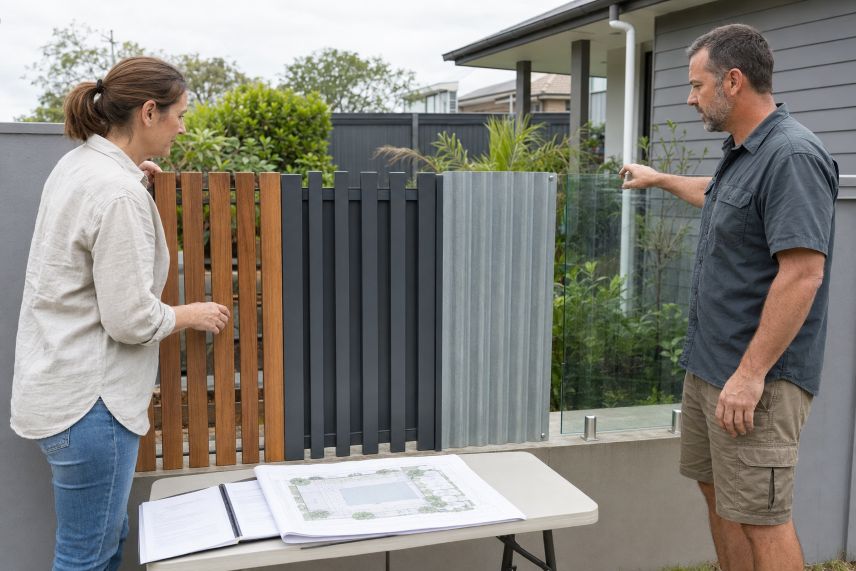
- Timber offers a warm, adaptable appearance and can provide strong privacy. It generally requires periodic inspection, coating, and repair as it ages.
- Aluminum is lightweight, resistant to corrosion, and often used for open-style garden or pool barriers. Its gaps and rails must still suit children, pets, and relevant safety rules.
- Colorbond steel creates a solid screen with no spaces between panels. It may suit privacy-focused yards, although color, airflow, glare, and local design controls should be considered.
- Glass preserves views and is commonly chosen around pools. Families should allow for regular cleaning and ensure the complete barrier, including gates and hardware, remains compliant.
- Masonry, composite, wire, and mixed-material fences can address specific design or site needs. Their weight, maintenance, visibility, and installation requirements vary considerably.
Local conditions should guide the final comparison. The Australian Government’s Your Home guidance highlights the importance of low-combustibility construction in bushfire-prone locations. Nearby trees should also be reviewed because roots, falling branches, and ongoing pruning access may affect fence placement and upkeep. Families can consult this guide to home tree care and maintenance when planning how the fence and established landscaping will be managed together. Coastal exposure, strong winds, sloping land, unstable soil, and nearby retaining walls may further influence posts, footings, finishes, and material selection.
Step 6: Plan Installation and Future Maintenance
A professional installer can confirm measurements, identify underground services, align gates, select suitable footings, and coordinate the work with pool, planning, and boundary requirements. Homeowners should request a written scope covering removal of the old fence, materials, gate hardware, site preparation, waste disposal, warranties, and responsibility for approvals.
Before accepting the completed work, walk the full fence line. Test every latch, inspect ground-level gaps, check for sharp edges, and confirm that panels and posts feel stable. Schedule regular checks after storms, ground movement, landscaping work, or heavy gate use.
A Fence That Can Adapt With the Family
The most suitable fence is rarely determined by appearance alone. It should respond to the household’s present risks while allowing for changing routines, growing children, new pets, and future outdoor improvements. A careful assessment, informed material comparison, neighbor consultation, and compliant installation create a boundary that remains practical long after the project is finished.